6 PROPOSED 5D FRAMEWORK
This research proposes a new ethical framework, that we have entitled the 5D Framework, for the development of inclusive home-based smart technology by combining the research presented above with aspects of the five-phase design thinking model proposed by the Hasso-Plattner Institute of Design (d.school), at Stanford, USA (Apiyanti and Dewi, 2019), as well as elements of the UK Design Council’s Double Diamond Model (Howard, et al., 2008).
Crucially, the Framework emphasises that the user is at the heart of the entire framework - they must be the co-designers of the system; in combination with the O’Keefe and O’Brien ethics model and the practical application of ethics in value-sensitive design (Friedman, 2013), these two dimensions are present in all five stages of the framework. The Design Team are a team of participants that include the end-user, as well as experts in technology, medicine, therapy and rehabilitation. Presented in Appendices A and B are a pair of checksheets that can be used as prompts for system developers with some of the key ethics issues that are important for these systems, echoing themes identified in Section 2, as well as the O’Keefe and O’Brien (2018) Framework and in value-sensitive design (Friedman, 2013). The checksheet in Appendix A focuses on data-level ethical considerations, and the one in Appendix B focuses on system-level issues.
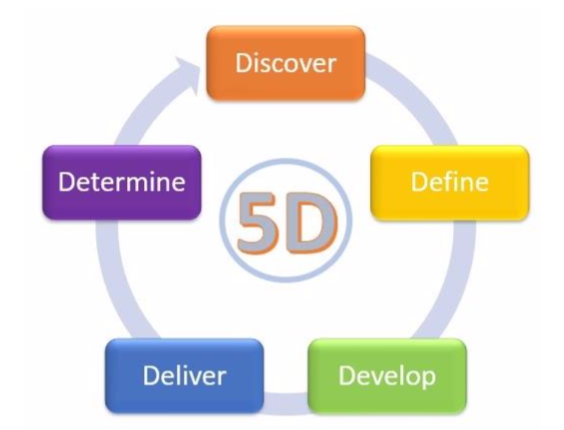 Figure 4 The 5D Framework
The 5D Framework is as follows:
1. Discover
In this stage the full Design Team are trying to understand the needs of the end-user of the system. They, therefore, will speak to the enduser in a thoughtful and solicitous manner, as well as other parties that may provide useful insights. The end-user is also asking questions.
They may use techniques from Software Engineering, including Requirements Gathering and Knowledge Eliction (Sommerville, 2015).
They may use design and research techniques including interviews, ethnographical diarying, and shadowing (Creswell, 2021).
From an ethics perspective, the O’Keefe and O’Brien (2018) Framework (looking at Dignity, Autonomy, Necessity, and Good).
Assess potential benefit and harm for every stakeholder group as proposed in (Friedman, 2013)
Basic research ethics protocols must also be used, adhering to standard policies and codes, and it would be expected to undergo a formal ethics approval.
2. Define
In this stage the full Design Team are trying to encapsulate their findings from the Discover Stage into a series of models, noting key challenges (pinch points and pain points) as well as existing affordances. Again, the end-user is a core member of the Design Team, and they are both the subject of the design, and the architect of the solutions.
They may use techniques from Software Engineering, including Use Case Diagrams and Data Flow Diagrams (Sommerville, 2015).
They may use design techniques such as MindMaps (or Spider Diagrams) and Gap Analysis to help clarify their thinking (Buzan and Griffiths, 2013).
They may also refer to Assistive Technology models such as the HAAT (Human, Activity, Assistive Technology) and the TAM (Technology Acceptance Model) (Cook, et al., 2020).
From an ethics perspective, the O’Keefe and O’Brien (2018) Framework (looking at Dignity, Autonomy, Necessity, and Good)
3. Develop
In this stage the full Design Team are working on identifying a range of potential approaches to addressing the issues identified in the two previous stages. Again, the end-user will be a vital force in the stage.
They may use techniques from Software Engineering including Paper Prototyping and “Wizard of Oz” Prototyping (Sommerville, 2015).
They may use design techniques such as the Six Thinking Hats and Ishikawa Diagrams (Michalko., 2006).
A research ethics review should be done at this point to ensure that none of the proposed solutions diverge significantly from the formal ethics approval.
This is likely to be the most iterative and cyclical stage.
4. Deliver
In this stage the full Design Team are selecting a single potential solution from those developed in the previous stage. In this stage it is vital that the end-user is asked and listened to.
They may use techniques from Software Engineering including Vertical and Horizontal Prototyping (Sommerville, 2015).
They may use design techniques including User Stories and Storyboards (Sommerville, 2015), Personas, Empathy Maps (add ref)
The checksheets in Appendices A and B should be discussed in meetings, and reflected on carefully. The team may also consider undertaking a Data Protection Impact Assessment at this stage (Bieker, 2016).
5. Determine
In this stage the full Design Team are testing the effectiveness of their solution. The system is deployed and the team are determining what aspects of the system work well, and which are not fully serving their purpose. This section includes considerations relating to maintenance and sustainability.
They may use techniques from Software Engineering including User Acceptance Testing and Performance Testing (Sommerville, 2015).
They may use design techniques such as groupbased roleplay and the Think-Aloud Protocol (Norman, 1986).
They may use educational techniques such as Reflective Practice and Metacognitive Strategies (Gravells and Simpson, 2014).
The checksheets in Appendices A and B are crucial at this stage of the process. They must also consider undertaking a Data Protection Impact Assessment at this stage (Bieker, 2016) as well as the O’Keefe and O’Brien (2018) First Principle Test. A research ethics review should also be done at this point to make sure no research ethics violations have occurred. All team members must consider if there are any lingering ethical issues that need to be addressed.
Table of Contents
- 1 INTRODUCTION
- 2 HOME-BASED SMART TECHNOLOGY
- 3 ETHICS AND TECHNOLOGY
- 4 HUMAN CENTRED DESIGN
- 5 PERSONAS AND ETHICS
- 6 PROPOSED 5D FRAMEWORK
- 7 CONCLUSIONS
- ACKNOWLEDGEMENTS
- REFERENCES
- APPENDIX