5 PERSONAS AND ETHICS
Personas are a useful tool in a human centred design approach to understand and communicate user needs and requirements. If designers want to test potential solutions, but don’t have continuous access to the end-users, they can create fictional characters that can be used to represent a collection of the kinds of people who could be using that potential solution, called personas (Cooper, et al., 2014). Although some researchers have criticised the use of personas by pointing out that real customers are preferable to the use of personas, there are many cases where this is not possible, so personas are an effective, if somewhat inferior, alternative (Salminen, et al., 2018). Studies such as Long (2009) have shown that personas can result in many benefits, including: more usable designs, more user-centred discussions, and more effective communication in design teams.
In this case, we have developed personas for this process for design ideation to help create stories that bring to life the existing data, theory and literature (Gordon, et al., 2013) to help to understand and communicate the key ethical issues presented above. The two personas are as follows:
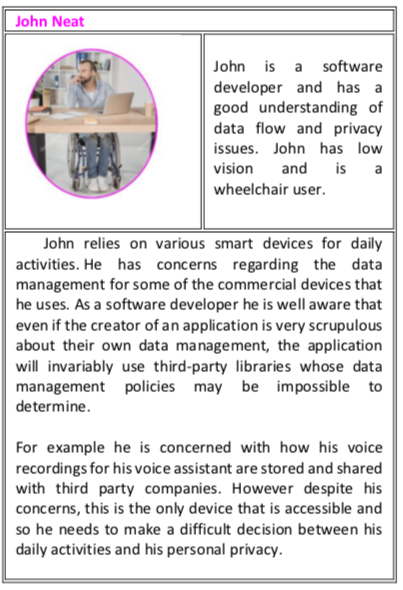
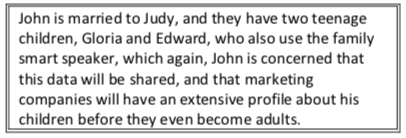
John Neat
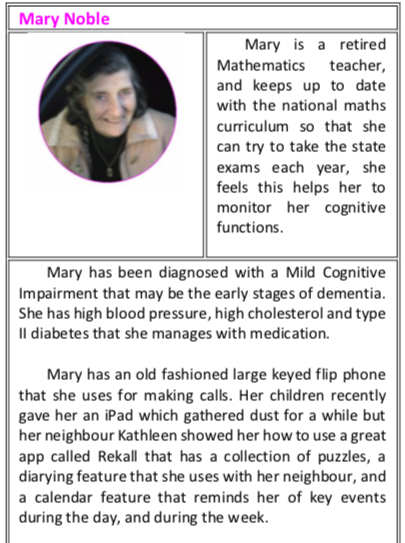
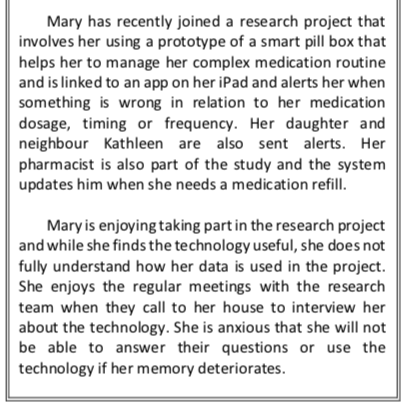
Mary Noble
In the first persona, John Neat, we have tried to synthesise the unique ethical and privacy implications that arise for people who are reliant on a device or technology due to health conditions or disabilities. Accessibility requirements can generate unique challenges and lack of choice that can pose difficult choices for individuals and create an unfair trade-off between personal ethical concerns with benefits to health and everyday quality of life. In this persona, John has to balance his independence through the use of a voice assistant and the risk to privacy of his family. We have tried to visualise this trade-off using a matrix based on the O’Keefe and O’Brien (2018) model presented in figure 1 but this time considering the utility of a technology vs. the ethical risk posed (see figure 3).
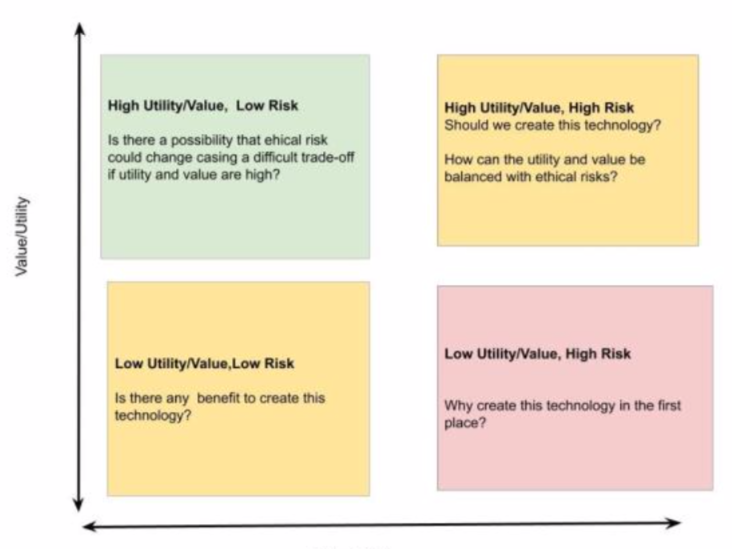 Figure 3 Considering the trade-off between utility and ethical risk that is particularly relevant to older adults and people with disabilities.
In the second persona we describe a relatively simple smart pill dispenser that sends alerts to the end user and their network of care. We tried to highlight in this persona the challenges that need to be addressed when a research participant has low digital literacy which will affect her use of the devices but her understanding of the data flow and data management within the research project. If these are not accessible, there are ethical risks around autonomy and consent for the research and related technology. Mary also has a cognitive impairment that may worsen over time and this also highlights that there can be ethical risks for the sustainability of a system that is designed to support a person at a point in time but may become redundant if their situation, health or capabilities change. Finally, we tried to illustrate the importance of the relationship between a researcher and participants in studies that deploy home-based smart technologies. Participants like Mary may enjoy the social aspects of being part of a research project and the effects of this need to be considered after the technology is withdrawn and a study ends. The relationships between participants, their networks of care, researchers, technology designers need to be considered in the design of any research project that involves home-based smart technology.
Table of Contents
- 1 INTRODUCTION
- 2 HOME-BASED SMART TECHNOLOGY
- 3 ETHICS AND TECHNOLOGY
- 4 HUMAN CENTRED DESIGN
- 5 PERSONAS AND ETHICS
- 6 PROPOSED 5D FRAMEWORK
- 7 CONCLUSIONS
- ACKNOWLEDGEMENTS
- REFERENCES
- APPENDIX