Literature Review and Hypotheses Development
According to Mehrabian and Russell (1974), S-O-R theory posits that stimuli (S) are triggers of changes in peoples’ organismic/internal states (O), bringing about their avoidance or approach responses (R). The S-O-R framework is used in the hospitality industry primarily because it parsimoniously describes environments, intervening variables, and behaviors (Ali, 2016). There is a significant association between customers’ perception of the servicescape and the customers’ internal responses (physiological, emotional, cognitive), and behaviors (avoidance/ approach) (Bitner, 1992). Thus, grounded on S-O-R, this study develops a model that suggests therapeutic servicescapes as an antecedent of revisit intention through COVID stress. Thisframework suggests that stimuli could be covert or overt, which nonetheless induces people’s internal state in a bid to motivate particular behaviors. Jacoby (2002) advanced S-O-R when he introduced a flexible and more comprehensive model where three types of stimulus, organism, and response factors were suggested. This revealed the models’ dynamic nature and adaptability, particularly in the hospitality industry. As argued by Rosenbaum et al. (2020), therapeutic servicescapes can be considered as stimuli. In the context of recreation and leisure establishments, therapeutic servicescapes is expected to be stimuli that influence the psychological/internal states of customers such as COVID stress (Taylor et al., 2020). Thus, therapeutic servicescapes of recreation and leisure establishments (stimuli) are linked to customers’ COVID stress (organism) which then ultimately influences customers’ intention to revisit the recreation and leisure establishments (approach response).
Therapeutic landscape describes the cathartic functions that some milieus, settings, or places may take up in peoples’ lives, once a meaningful confluence of social and physical stimuli exists. A therapeutic landscape emerges when human perceptions, social conditions, and physical and built environments blend to create an environment conducive for healing (Gesler, 1996). The therapeutic potential of places has been studied in the literature—urban and residential areas, religious sites, blue spaces (e.g., beaches, rivers, islands), and green spaces (e.g., gardens, outdoor spaces, and parks) (Bell et al., 2018). The studies show that people seek to maintain closeness to such milieus, settings, or places that promote their wellbeing (Ramkissoon et al., 2018). Consequently, marketing scholars have suggested that the union of social as well as physical components in commercial locations might spur consumers’ desire to remain close to such setting, as patronage provides wellbeing benefits like obtaining social support from people present in the setting, and relief from depression or stress (Temerak et al., 2018; Zablah et al., 2017). Therapeutic servicescapes are places of service delivery that have a blend of social and physical components to create an environment that fosters wellbeing and is conducive for healing. Not all consumption setting in the service industry is directly impactful on customers’ wellbeing, but such have the restorative potential of physical and social stimuli. Social stimuli, such as other customers present in service environments, volunteers, and employees, provide relational resources like; lighthearted chats and friendly banter (Altinay et al., 2019), which might stimulate customers’ mental and physical well-being (Lucia-Palacios et al., 2018). Certainly, customers patronize places of leisure to engage in light-hearted chats and laughter with others present, and in so doing, they do get momentary relief from the ills of everyday life (Cheang, 2002). In addition to social stimuli, scholars (Purani & Kumar, 2018) have revealed that physical/natural stimuli (such as, water displays & green areas), in commercial settings such as game arcades, zoos, casinos, and leisure facilities (Weber & Trojan, 2018) possess restorative stimuli that minimize, or sometimes remedy symptoms of burnout, exhaustion and mental fatigue. Combining these research streams, this study argues that if customers spend time in leisure or recreation settings with the confluence of restorative potential and relational resources, these spots could take on a therapeutic function in their personal experiences and daily lives.
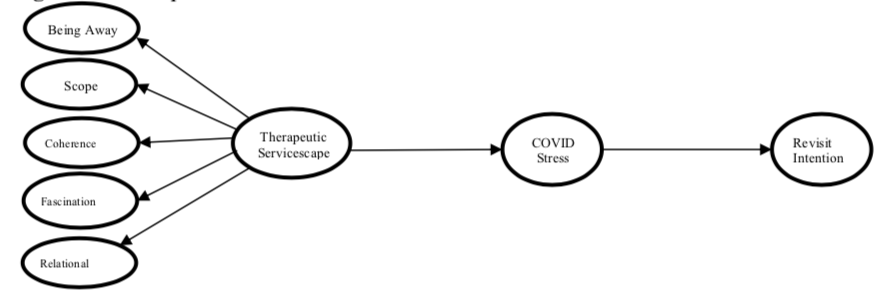
Drawing on attention restoration theory (ART), the ability to direct ones’ attention (such as one’s perception and thought) to undesired but important environmental stimuli (in the case of this study, the COVID-19 pandemic; increase infection rates, mortality rates, isolation, and lockdown), necessitates the use of the neurocognitive inhibitory mechanism, which becomes depleted with time (Kaplan, 1995). This depletion then results in symptoms and experiences associated with irritability, exhaustion, withdrawal, disinterest in habitual activities, mental fatigue, and stress (Li & Sullivan, 2016). ART studies (Moran, 2019) report that when individuals with symptoms and experiences related to directed attention fatigue interact with nature, it helps relieve their fatigued neurocognitive inhibitory mechanism. Relying on the ART, Pasini et al. (2014) argued that inherently, natural environments comprise of four conditions: being-away, scope, coherence, and fascination. Being away offers an individual respite from their day-to-day feelings and concerns and helps them momentarily escape to a ‘different place’. Scope refers to a setting being coherent and rich enough, that it seems to be outer-worldly in an individual’s perceptions. Such settings are engaging to the individual’s mind and provide plenty of stimuli to take up a considerable portion of the available room in the individual’s mind. Coherence describes a person’s ability to comprehend how a place is designed and organized, and how the person can fulfill goals using the place. In conclusion, fascination describes an environmental condition, which effortlessly gets peoples’ attention and does so without capacity limitations (Pasini et al., 2014). When these four conditions are combined, they collectively promote healing from symptoms related to exhaustion, mental fatigue, and stress. Following the arguments of Rosenbaum et al. (2020), this study pools restorative resources (four environmental conditions) and relational resources, available at a place of leisure and recreation as representing its therapeutic servicescape. Therefore, to reduce potential multicollinearity, therapeutic servicescape is measured in this study as one second-order construct, comprising of four variables from restorative resources and one variable from relational resources (Kenny, 2016; Rosenbaum et al., 2020). Since places of leisure and recreation may also have both restorative and relational resources, these places may consequently stimulate healing from COVID-19 directed attention fatigue and its ensuing symptoms of stress. Thus, it is hypothesized:
- H1: Therapeutic servicescapes at places of leisure and recreation will have a negative relationship with customers’ COVID stress.
As a favorable post-consumption behavior, revisit intention is described as customers’ perceived likelihood of coming back to the same destination (Loi et al., 2017; Pham & Nguyen, 2019).
Revisit intention has been referred to as the ultimate success of the servicescape in the hospitality industry (Kim & Moon, 2009). Contingent on their experience in the servicescape, customers respond either with avoidance or approach behaviors (Bitner, 1992). If they are pleased with their experience, they respond with approach behaviors which could include willingness to pay, exploration, staying longer, recommendation, and revisiting (Firat, 2019). Conversely, when customers are not pleased with the servicescapes, they respond with avoidance approach behaviors such as negative word-of-mouth and boycott. It is expected, based on the potential health-related benefits of a therapeutic servicescape that customers would respond with an approach behavior. The customers’ memorable and pleasant restorative and relational experience of therapeutic servicescapes would trigger the desire to visit the servicescape in the future, so as to have such pleasant and memorable restorative and relational experiences again. Thus, it is hypothesized:
- H2: Therapeutic servicescapes at places of leisure and recreation will have a positive relationship with customers’ revisit intention.
Studies of prior pandemics (and epidemics) reveal that stress or the lack thereof is a significant precursor of behaviors during and after the pandemic (Taylor, 2019). People with extreme anxiety and distress are more likely to engage in behaviors that might be socially disruptive, such as panic buying and over-utilizing of medical resources because they misread trivial ailments as symptoms of serious infection (Asmundson & Taylor, 2020). In the COVID-19 pandemic, as governments relax lockdown restrictions, those with extreme anxiety continue to excessively engage in preventative behaviors such as overly maintaining physical and social distancing, avoiding public gatherings, and staying home. These behaviors slow down the recovery of economic, social, and other activities post-pandemic, and have been said to be a source of concern (Taylor et al., 2020). As discussed above, it is expected that therapeutic servicescapes (with its restorative and relational resources) could help individuals overcome extreme pandemic-related anxieties and stress. Thus, this study hypothesizes that therapeutic servicescapes of places of leisure and recreation will have a positive relationship with customers’ revisit intention, through therapeutic servicescapes’ negative association with COVID stress. The alleviation of COVID stress could be a mechanism through which therapeutic servicescapes would influence customers’ revisit intention. Thus, it is hypothesized that:
- H3: COVID stress mediates the relationship between therapeutic servicescapes at places of leisure and recreation and customers’ revisit intention.
Figure 1: Conceptual Model