3 ETHICS AND TECHNOLOGY
In terms of ethical frameworks, individual ethical theories place different weight on the importance of intentions versus outcomes in evaluating actions. The utilitarian view is that everyone’s interests have equal weight. Deontology emphasises the intention to act in accordance with our duties (intentions), and believes the consequences of our actions have no ethical relevance. This is unlike consequentialism, which judges actions by their results or outcomes. Virtue ethics becomes increasingly popular in philosophy of technology. For example, Vallor (2016) has argued that virtue ethics with its focus on choices that aim at the ‘good life’ is ideally suited for managing complex, novel, and unpredictable moral landscapes, just the kind of landscape that today’s emerging technologies present. Value Sensitive Design (Friedman, 2013), defined as “a theoretically grounded approach to the design of technology that accounts for human values in a principled and comprehensive manner throughout the design process” is an example of Vallor’s (2016) application of virtue ethics to technology.
It is fair to say that the software engineering process has traditionally been driven by a more utilitarian approach by focusing on outcomes in terms of the development of commercial products or services. But a blind spot for intentions has led to many high profile ethical technology failures where software has displayed unintended consequences (e.g. biases or privacy violations) or been used in a different and unethical manner from that for which is was originally designed (e.g. data harvesting applications embedded in social media or facial recognition technology used for commercial purposes when it had originally been developed for law and order purposes). The recent emphasis on data management and governance and high profile data breaches have led to high level data management frameworks incorporating ethics, for example the UK’s Department for Digital, Culture, Media & Sport formulated an ethics framework in its National Data Strategy.
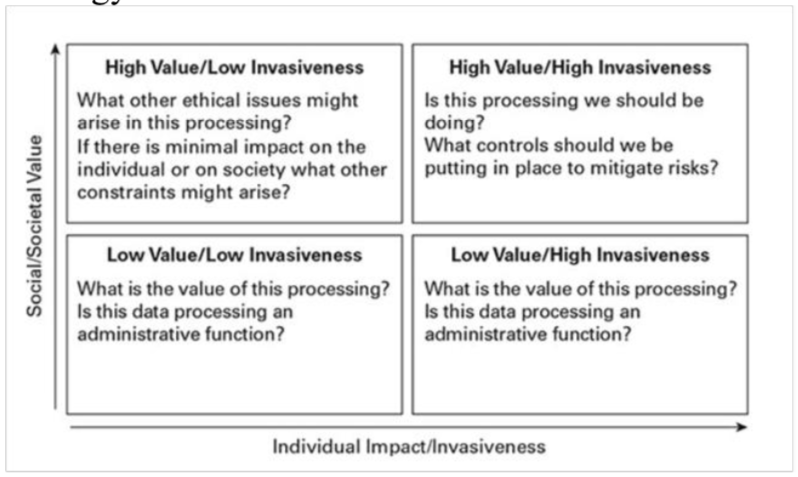 Figure 1 Framework to assess individual invasiveness of the outcome of data processing vs. societal value (O’Keefe and O’Brien, 2018).
Table 1 First Principles Ethical Test (O’Keefe and O’Brien, 2018) 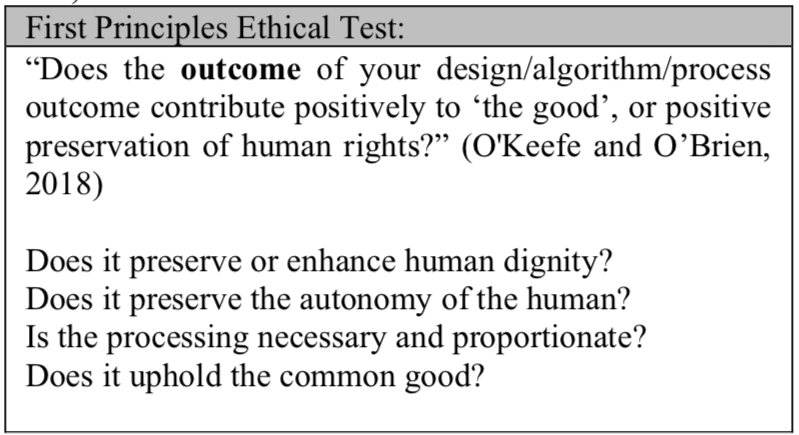
At lower levels, frameworks such as that by O’Keefe and O’Brien (2018) (Figure 1 and Table 1) offer organisations a practical guide to implementing data ethics. These frameworks have tended to follow the traditional trajectory in software engineering by focusing more on outcomes than intentions. Recent welcome developments have shifted the emphasis from outcomes to intentions to reduce blind spots in technology development, for example Consequence Scanning is an Agile approach that fits within an iterative development cycle and encourages organisations to consider the potential consequences of their product or service on people, communities and the planet (Brown 2019).
Research projects involving human participants undergo ethical assessments and more recently data protection impact assessments that are built on some of the outcome-focused ethical frameworks presented above but typically these occur at the end of the technology design phase. This point of ethical evaluation is usually late in the development of the technology or research project and focus on the impact of the system as designed on the research participants. At this point, it is arguably too late for researchers to consider questions such as “should this technology ever have been developed in the first place?”. We argue that a framework is required that allows us to reflect on ethical issues - those related to both intentions and outcomes - at challenge points throughout the technology life cycle.
Table of Contents
- 1 INTRODUCTION
- 2 HOME-BASED SMART TECHNOLOGY
- 3 ETHICS AND TECHNOLOGY
- 4 HUMAN CENTRED DESIGN
- 5 PERSONAS AND ETHICS
- 6 PROPOSED 5D FRAMEWORK
- 7 CONCLUSIONS
- ACKNOWLEDGEMENTS
- REFERENCES
- APPENDIX