Reported Cases of Femicide from Maquiladora Workers
The case of Nancy Villalba-Gonzalez exemplifies some of the dangers these young women encounter (Cacho, 2020). In 1999, 13-year-old Nancy reported the bus driver who drove her home from the Motores Electricos maquila raped her and left her to die in a ditch under a pile of concrete (Amnesty International, 2003). She was found in the desert a few days after she managed to free herself from underneath the pile of concrete and drag herself to a nearby home where they alerted the authorities. She testified against the driver Jesús Manuel Guardado Márquez, alias el Tolteca; he was linked to another 12 feminicides similar to what Nancy lived through (Cacho, 2020). The driver belonged to a group of men who called themselves Los Ruteros. It was suspected they were paid by El Sharif also to kill the young women for money. It was revealed they would get paid between one to twenty thousand dollars per victim (Cacho, 2020). They would wait for the last girl on the bus and take her to a designated spot in the desert where they would not be found until weeks or months later and often were not recognized. However, there was insufficient evidence to prove that El Sharif had any connection with the murders in Lote Bravo, and the disappearances and femicides in the city continued after his imprisonment (Cacho, 2020).
Two more murders that were linked to maquila employees are those of Coral Arrieta Medina, and Rocio Paola Marin in 2005 (Wola, 2007). Coral was 17 and was found in March, where her body was dumped in Lote Bravo, where there had been 18 other victims found in previous years. Lote Bravo was near the place where Nancy Villalba’s body was found. Coral was a maquila employee and student. She was found raped and strangled. Another body that was found was Rocio. She was found in an irrigation ditch in the city. She was 19 and her body showed she had been raped, tortured, and stabbed more than 15 times in the back, stomach, and neck (Wola, 2007).
Other cases include the 2001 finding of 17-year-old Lilia Alejandra Garcia, a maquila employee who was found wrapped in a blanket. It was concluded she died from asphyxia due to strangulation (Amnesty International, 2003). That same year, Claudia Ivette Gonzalez Banda, a worker at the LEAR 173 maquiladora was reported missing after being refused entry to the maquila for being two minutes late (Amnesty International, 2003). In 2002, the body of Merced Ramírez Morales, a worker at the Admeco maquila, was found by a group of children on the Cerro Bola. Her body showed signs of sexual assault. A few months later a skeleton wearing blue overalls was found at the entrance to the Juarez Industrial Park. The overalls belonged to the FASCO maquiladora and it was reported that the death occurred about twelve months before the finding of the remains.
Similarly, in 2001, in a field located in front of the Asociación de Maquiladoras de la Entidad which is the association linked to the oversight of maquilas in the area, the bodies of eight young women were found. Due to the state the bodies were in, only one of them was to be identified as Claudia Ivette (La Redaccion, 2005). The people who confessed to these crimes were two bus drivers nicknamed El Cerillo (The Match) and La Foca (The Seal). However, they later claimed they were harassed and coerced by the authorities to make a statement that would incriminate them. El Cerillo was released from prison three years after his sentence because of the lack of evidence from prosecutors. Both drivers confirmed they were pushed by the state to confess because of the pressure the local government was receiving after finding the eight bodies (La Redaccion, 2005). The finding of the eight bodies shocked the locals and sparked protests around the city. Women demanded justice for the eight girls by painting pink crosses and placing them in the field where the bodies were found hoping this would attract the attention of local authorities and the press (Amnesty International, 2003).
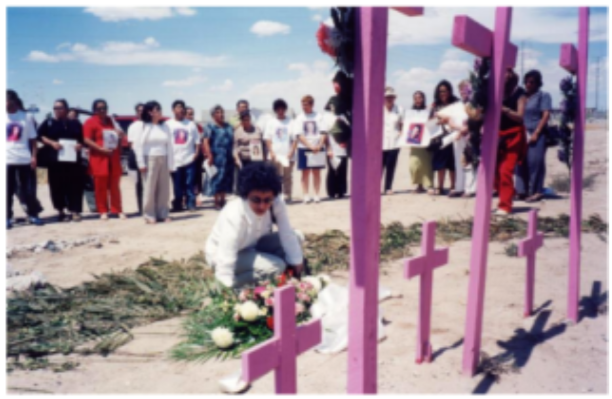 Figure 2. Eight crosses are placed on the field by the Maquiladora Association to demand justice for the victims (Amnesty International, 2003).
Another case is that of the Three Reyes maquila in which multiple women reported being harassed by the male upper management and those same factory women rarely hold management positions. Those who do often feel inadequate and like they are not being respected in their position (Wright, 1997). Complaints like this are not exclusive to the Three Reyes maquila, multiple others in the city have similar claims of young women being harassed and exploited by their male coworkers. Human Rights Watch created an investigation when it was found that many women were routinely given pregnancy tests and asked in their interviews if they desired to become pregnant within the next few months (Human Rights Watch, 1996). To keep costs lower and avoid the mandatory maternity leave under Mexican law, the management at the maquilas would perform the pregnancy tests or ask female workers to track their menstrual cycles by showing their used feminine products (Livingston, 2004). If a woman became pregnant she would be immediately fired if applicable or intimidated until she resigned from her position (Livingston, 2004 ). Similar reports were found in multiple maquiladoras in the state of Chihuahua (Wright, 1997).
News articles and published reports since 1993 started to raise awareness on the topic by showcasing some of the horrors of these crimes. More recent articles have called attention to the femicides across the city beyond the maquila industry. Most people become aware of the femicides after there is a mass protest like Esther Cano’s 1993 International Women’s Day march where she met with maquiladora workers to demand action and protection for the young women (Osborn, 2004). Through protests like the one Cano executed and, through the news articles, femicides began to gain momentum (Vulliamy, 2020). Protests all around the country have erupted with the biggest day being March 8th, known as international women’s day in response to Cano’s. The alarming rate of femicide in the country has attracted international attention in recent years since Mexico began these protests (Chin, C., & Schultz, E.,2020). Current protests are similar to Cano’s in Juarez after the reports of feminicide in maquilas during the 1990s were released since they march in the streets and use art to express their frustrations (Vulliamy, 2020).
The direct impact of maquilas goes beyond the femicides in the city. Even if the women do not fall victims to it there are other harassment claims and unequal pay. Many women who worked in the maquilas reported being subjected to routine pregnancy tests and if they became pregnant they were forced to resign (Kelly, 2001). These women also reported being controlled by male plant managers and supervisors. These women work long hours and the wages are often not sufficient (Kelly, 2001). These women often have to choose between food and transport money with many of them being young single women who have to take care of their families (Kelly, 2001). The harassment suffered by these women is considered an extension of the patriarchal authority beyond the home.
Table of Contents
- Introduction
- Methodological Approach
- A brief history of feminism and femicide
- NAFTA and other factors that can affect maquiladoras
- Reported Cases of Femicide from Maquiladora Workers
- Discussion
- Limitations and Future Studies
- Conclusion
- Works Cited