A brief history of feminism and femicide
Ciudad Juarez is located in the state of Chihuahua in the region of Northern Mexico, next to the Rio Grande. It connects Mexico and the United States through El Paso and it is considered a business hub with a large sum of the maquilas being concentrated in the area (Figure 1) (Livingston, 2004). Cuidad Juarez became known for its relation to violence during the 1990s when the bodies of two hundred women were found in the desert, with many of them showing signs of rape and torture. Ciudad Juarez is also known for its industrial park that is lined with low-waged factories where people from all over the country migrate to work (Livingston, 2004). In 2010, Ciudad Juarez was considered one of the most violent cities in the world (Vulliamy, 2020). Corruption and the drug trade have run rampant across the city and local politicians and police forces have been found to have ties with the local cartels (Camacho, 2006). Impunity is the norm in the city where thousands have gone missing over the years (Vulliamy, 2020).
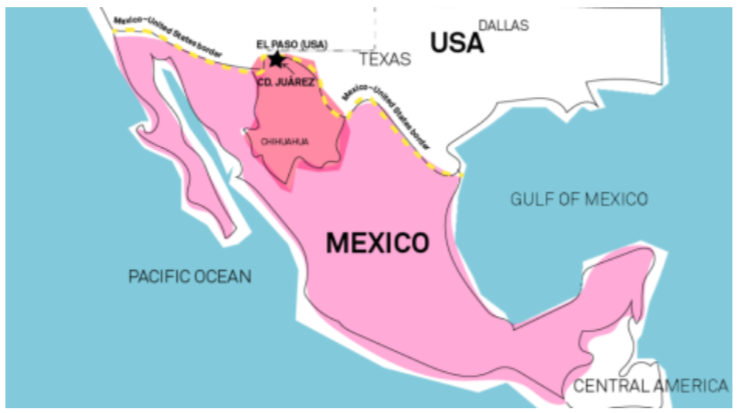 Figure 1. Map of Mexico with a star pointing at Ciudad Juarez. (Linnert et al.)
The term femicide was coined by Diana E. H. Russell in 1976 and it refers to the murder of women because they are women (World Health Organization, 2012). The word femicide and feminicide are used interchangeably in the literature review. There are multiple types of femicide, this paper will focus on the non-intimate type. This type is characterized by the killing being perpetrated by someone who does not have an intimate relationship with the victim (World Health Organization, 2012). Most non-intimate femicide affects working women, especially in stigmatized professions such as sex work or working in bars or nightclubs. Non-intimate femicide is less common but still poses a large threat to young working women, which maquiladoras are known for having a younger unmarried workforce.
Multiple cases of femicide have been reported in Juarez after 1993 reports found shallow graves where bodies were dumped across multiple locations in the city (Pantaleo, 2010). These corpses were often unidentifiable or showed signs of brutal violence (Wright, 2001). The bodies would often show signs of sexual assault; their nipple would be bitten off, and their bottoms would show lacerations or forms of branding. The women would be penetrated with objects and would show signs of rape during the investigations conducted (Livingston, 2004). It was determined in 1999 that 30 percent of the victims found were employed at maquilas around Ciudad Juarez (Wright, 2001). Many of these young girls would be abducted/kidnapped during their transit to and from work. The maquiladoras denied having any connection to the rising rate of victims found (Wright, 2001).
In 1995, mass protests erupted when Esther Chavez Cano revealed the reports of the murdered and missing women in the city, in El Diario de Ciudad Juárez, a local newspaper (Wright, 2001). The publication exposed that since 1993, over 50 corpses of women had been found. Chavez took the initiative on March 8th, international women’s day, to storm political conferences, paint wooden crosses that were placed around the city pink, create mass searches in areas where bodies had been previously found, and try to make agreements with maquila workers to change the conditions of the factories (Wright, 2001). This act was seen as one of the biggest protests Ciudad Juarez has held and it was the beginning of the many more to come over the next years (Uribe, 2020). Esther Chavez Cano was a prominent activist who sought justice throughout her life to stop the violence and change the image of women within the maquilas. She was a core piece in the mobilization of the feminist movement in Ciudad Juarez (Wright, 2001). Cano created safe spaces for women to live in if they were being abused.
The maquiladora industry is rife with gender-based disparities connected to the idea of females being subservient and belonging to work in the maquiladoras. Women were selected to work in the maquilas because of the belief they are more willing to work the long hours and endure the repetitive process in the assembly line compared to men (Livingston, 2004). There have been various reports of maquila employers sexually harassing employees as well as performing routine pregnancy tests, proof of menstruation, and not providing adequate working conditions (Garwood, 2002). These women are later forced to resign if they decide to start a family or are not hired if they are pregnant or want to start a family (Human Rights Watch, 1996). The image of working women is tarnished in the city. They have often been regarded as prostitutes or bad girls who live a double life for desiring financial independence (Livingston, 2004).
Table of Contents
- Introduction
- Methodological Approach
- A brief history of feminism and femicide
- NAFTA and other factors that can affect maquiladoras
- Reported Cases of Femicide from Maquiladora Workers
- Discussion
- Limitations and Future Studies
- Conclusion
- Works Cited